

Johns Creek is one of the most affluent and densely developed cities in north metro Atlanta, and the homes here reflect that. The majority of the housing stock was built between the late 1980s and the mid-2000s, when large two-story colonials, brick-front traditionals, and custom builds on wooded lots defined the look of every new subdivision from Medlock Bridge Road to State Bridge Road. Those homes are now at the age where the original mechanical systems are either on their last legs or already on their second replacement cycle.
What makes Johns Creek different from other north Georgia communities is the scale of the homes themselves. Many of the houses here exceed 3,000 square feet, and a good number were built with zoned HVAC systems designed to manage heating across multiple levels and wings. When one component of a zoned system fails, the performance drop can be subtle at first, confined to one zone while the rest of the house feels fine. By the time the problem becomes obvious, it has usually been developing for a while.
Conditioned Air Systems has been serving the north Georgia and north metro Atlanta area since 1983. We understand the complexity of the systems in Johns Creek homes and have the training and experience to service them correctly.
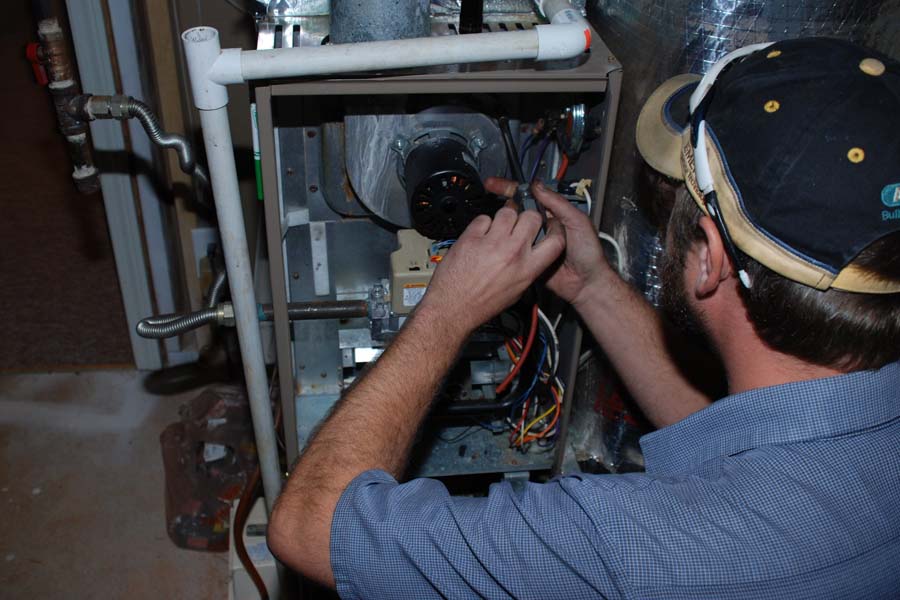
In larger homes with zoned systems, furnace problems can hide longer than they would in a smaller single-zone house. These are the signs worth watching for, even when most of your home feels comfortable.
That last one trips up a lot of Johns Creek homeowners. A failed zone damper actuator can make it look like the furnace is underperforming when the actual issue is that conditioned air is not being directed where it needs to go. Diagnosing zoned system problems takes someone familiar with how those systems are configured, not just how furnaces work in general.

The age range of Johns Creek’s housing stock puts a large share of its furnaces squarely in the 15 to 30 year window, and that is where the most significant problems tend to cluster. Heat exchanger failure is at the top of the list. In homes this age, particularly those that have had inconsistent filter maintenance, the heat exchanger has been through enough thermal stress cycles that cracking becomes a real risk. We inspect heat exchangers carefully on every visit in this community because the consequences of a missed crack go beyond comfort.
Zoned system component failures are another pattern specific to Johns Creek. Zone damper actuators wear out over time, zone control boards develop faults, and bypass dampers that were never properly balanced cause pressure problems that stress the blower motor and reduce system efficiency. These issues rarely show up as a single dramatic failure. They tend to accumulate quietly until the system is working far harder than it should be just to maintain temperature.
We also respond regularly to dual-fuel system issues in this area. A number of Johns Creek homes were built with heat pump and gas furnace combinations designed to switch between fuel sources based on outdoor temperature. When the changeover logic fails or the heat pump loses efficiency, the gas furnace ends up carrying more of the load than it was designed to handle alone, and the added wear shows up fast.

Larger homes with complex HVAC configurations require a more thorough diagnostic process than a standard single-zone system, and we account for that from the moment we arrive. Our technician reviews the full system layout before starting, including zone control wiring, damper positions, and thermostat programming, so the diagnosis reflects how the system is actually supposed to operate rather than just how it is behaving at the moment.
From there we inspect every critical component: heat exchanger integrity, burner operation, ignition system, flame sensor, blower motor performance, flue venting, and all safety controls. For zoned systems we test each zone independently to isolate whether the problem is in the furnace itself, the zone control board, a damper actuator, or the duct configuration. Getting that distinction right is what separates a clean repair from a misdiagnosis that sends you in the wrong direction.
All repairs are backed by our full one-year warranty on parts and labor. Our NATE-certified technicians train monthly on all makes and models, including the multi-stage and variable-speed equipment that is common in Johns Creek’s larger homes. We do not treat a 4,000 square foot zoned home the same way we treat a 1,200 square foot ranch, and that attention to context is part of what keeps our customers calling us back.

Chartwell is one of the established subdivisions in Johns Creek with homes that were built primarily in the 1990s, many of them large two-story colonials with basement levels and original dual-zone HVAC systems. We got a call last winter from a homeowner named Vanessa whose upstairs zone had been noticeably cooler than the rest of the house for several weeks. She had assumed it was a thermostat issue and had already replaced the upstairs stat before calling us.
When our technician arrived and ran through the system, the thermostat turned out to be fine. The actual problem was a combination of a failing zone damper actuator on the upstairs trunk line and a blower motor that was running below its rated speed due to a capacitor that was on its way out. The damper was not opening fully, which restricted airflow to the upper level, and the weakened blower could not compensate for the restriction. Together they created exactly the kind of subtle zone imbalance that is easy to misread as a thermostat problem.
We replaced the capacitor, restored the blower to full speed, and replaced the faulty damper actuator. Vanessa said the upstairs felt better within the first cycle after we finished. The diagnosis took longer than a simple repair would have, but getting it right the first time meant she was not back on the phone with us two weeks later chasing the same problem from a different angle.
Larger homes with complex systems need a company that brings real expertise to the door, not just a technician with a checklist. Here is what we offer every Johns Creek homeowner who calls us.
We have more than 75 trained professionals across north Georgia and north metro Atlanta ready to respond. When your system is as complex as your home, you want a company with the depth to handle it properly from the first visit.
Zone imbalances are usually caused by a failed damper actuator, a fault in the zone control board, or a blower motor that has lost capacity and can no longer push adequate airflow to the farthest zones. A technician familiar with zoned systems can isolate the cause quickly and avoid misdiagnosing it as a thermostat issue.
A cracked heat exchanger often presents as a flickering or yellow burner flame, soot buildup near the furnace, unexplained headaches or carbon monoxide detector alerts, or a system that shuts down shortly after starting. Visual confirmation requires a trained technician with the right tools. If you suspect a cracked exchanger, do not continue running the system until it has been inspected.
Yes. Our technicians are trained on dual-fuel systems and understand how the changeover logic between the heat pump and gas furnace is supposed to work. If the system is defaulting to gas more than it should or not switching correctly, we can diagnose and correct the issue on a single visit in most cases.
At least once a year before heating season, and ideally twice a year if the system also handles cooling. Zoned systems have more components that need periodic inspection and calibration than single-zone setups, and staying on a regular maintenance schedule is the most reliable way to catch developing problems before they become expensive repairs.
Yes. We provide 24/7 emergency service throughout north Georgia and north metro Atlanta, including Johns Creek and Fulton County. If your heat goes out overnight or on a weekend, call us and we will get a technician to your home as quickly as possible.