

Oakwood occupies a busy stretch of Hall County between Gainesville and Flowery Branch, and its position along the Highway 60 and I-985 corridor has shaped it into one of the more commercially active small cities in the region. But behind the retail strips and business parks, Oakwood has a residential character that is easy to overlook. Its neighborhoods span several decades of construction, from modest postwar homes near the older town center to the subdivisions that filled in rapidly during the growth years of the 1990s and early 2000s as Hall County’s population expanded southward toward the lake.
That layered development timeline creates a heating service picture that is genuinely mixed. A homeowner in an older Oakwood neighborhood may be running a furnace that has outlasted two sets of neighbors, while a homeowner two streets over in a 2003 subdivision is dealing with equipment that is just now entering its most failure-prone years. Both homes sit in the same city, face the same Hall County winters, and deserve the same quality of diagnosis and repair.
Conditioned Air Systems has been headquartered in Gainesville and serving all of Hall County since 1983. Oakwood has been part of our territory since the beginning, and we know these neighborhoods and the equipment running inside them.

Whether your Oakwood home was built in 1965 or 2005, a furnace in trouble tends to give the same kinds of signals. These are the ones worth picking up the phone about before they turn into an emergency.
A blower that keeps running after the heat cycle ends is something a lot of Oakwood homeowners notice but do not immediately connect to a furnace problem. It often points to a limit switch that is tripping from overheating, which can be caused by a dirty filter, blocked return air, or a heat exchanger that is beginning to fail. Any of those causes warrants a professional look.
Oakwood’s proximity to Lake Sidney Lanier puts parts of the city in the same humidity band that affects Flowery Branch to the south. Neighborhoods closest to the water and the low-lying areas near the lake’s feeder creeks experience elevated moisture levels that accelerate corrosion on heat exchanger surfaces, burner components, and flue connectors. We see this pattern in homes that sit in the lower-elevation sections of Oakwood more consistently than in the higher ground neighborhoods closer to the Highway 60 corridor.
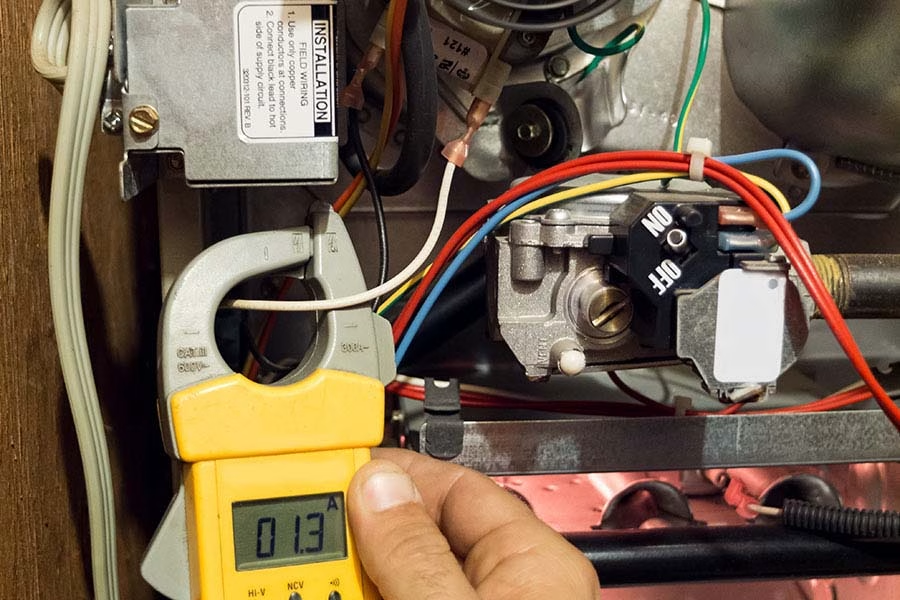
The 1990s and early 2000s subdivisions in Oakwood are producing a steady volume of blower motor and capacitor failures right now. Equipment installed during that building period is between 20 and 30 years old, and the capacitors that keep blower motors running efficiently have a finite service life that many of those systems have now exceeded. A capacitor failure causes the blower to run hot and inefficiently before it fails entirely, and by the time a homeowner notices the airflow problem the motor may already have sustained additional wear from operating without proper starting assistance.
We also field frequent calls from Oakwood homeowners dealing with heat exchanger issues in older systems. The combination of age, periodic humidity exposure from the lake’s influence, and furnaces that have operated for years without professional maintenance creates conditions where heat exchanger deterioration moves faster than it would in a drier or more regularly serviced environment. We take heat exchanger inspections seriously on every call here because the stakes of missing a crack are not minor.
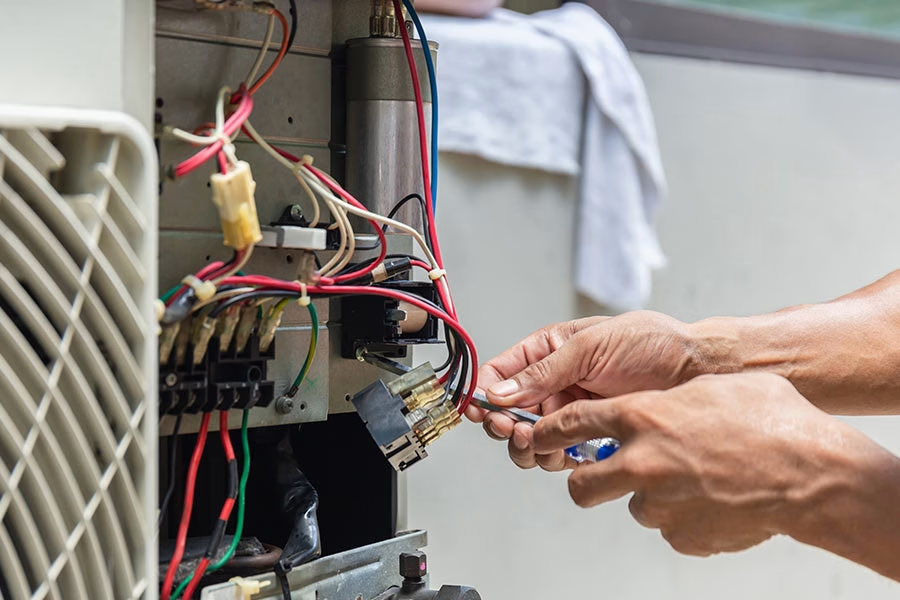
Our approach to furnace repair in Oakwood is the same as it is everywhere we work, and it starts with a complete diagnostic before any recommendation is made. We inspect the heat exchanger for cracks and corrosion, test the ignition system and flame sensor, check burner operation and combustion quality, evaluate the blower motor and capacitor, examine the flue connector and venting path, and verify all safety controls are functioning correctly. For homes in lower-elevation sections near the lake, we pay particular attention to corrosion indicators that may not be obvious without a close look.
After the inspection we give you a clear picture of what is going on, ordered by what matters most. Safety issues come first. Reliability issues come next. Items that are developing but not yet urgent are noted separately so you have the full context without feeling like everything needs to happen today. We have found that most homeowners appreciate that kind of straightforward breakdown, and it is the only way we know how to do this work honestly.
Every repair carries a full one-year warranty on parts and labor. Our NATE-certified technicians train monthly on all makes and models, and we specifically maintain proficiency on the older equipment generations that make up a large portion of Oakwood’s residential heating systems. When we leave your home, the system has been tested under operating conditions and confirmed to be running correctly.
The Mundy Mill area sits along the southern edge of Oakwood near the Hall and Gwinnett county line, and it has seen consistent residential development over the past two decades. The homes there represent a mix of early 2000s construction and more recent builds, and the equipment ages reflect that range. Last winter we got a call from a homeowner named Sandra whose furnace had been running almost nonstop for three days following a cold front that pushed overnight lows into the upper teens.
When our technician arrived and ran through the diagnostic, two things stood out. The blower motor capacitor had degraded to the point where the motor was drawing significantly more current than its rating to achieve the same airflow, and the return air path was partially blocked by a filter that had not been changed in what looked like the better part of a year. Together those two issues were causing the limit switch to trip repeatedly, which forced the blower to run continuously in an attempt to cool the heat exchanger back down between cycles. The furnace was not so much heating the house as it was working itself into exhaustion trying to recover from its own overheating.
We replaced the capacitor, installed a fresh filter, verified the limit switch was resetting correctly, and ran the system through several normal heat cycles to confirm everything was operating within spec. Sandra said the difference was noticeable within the first hour. Two relatively straightforward fixes had been compounding each other into a problem that felt much bigger than either one was on its own. That is exactly why a thorough diagnostic matters more than a quick guess.
We are not a company passing through Hall County chasing calls. We are based here, we have been here for over 40 years, and Oakwood is part of the community we built this business to serve. Here is what that commitment looks like when you call us.
More than 75 trained professionals are ready across north Georgia. When your furnace needs attention in Oakwood, you are calling a neighbor, not a call center.
A blower that runs continuously after a heat cycle usually means the limit switch is tripping from an overheated heat exchanger. Common causes include a dirty or blocked filter restricting return airflow, a failing capacitor causing the blower to underperform, or a heat exchanger that is beginning to crack. A technician can identify the root cause quickly and address it before it leads to more serious damage.
Yes. Homes in the lower-elevation sections of Oakwood near the lake and its feeder creeks experience elevated humidity that accelerates corrosion on heat exchanger surfaces, burner components, and flue connectors. Regular annual maintenance catches that corrosion early, before it compromises safety or forces a premature system replacement.
The capacitor provides the electrical boost the blower motor needs to start and run efficiently. When it degrades, the motor draws more current to compensate, runs hotter than it should, and eventually fails entirely. Signs of a failing capacitor include weak airflow, a humming sound from the furnace cabinet, or a blower that is slow to reach full speed. It is one of the more common repairs in equipment that is 15 to 25 years old.
Once a year before heating season is the standard recommendation for most systems. For older equipment or homes in lower-elevation areas with higher humidity exposure near the lake, staying on that annual schedule is especially important because corrosion and component wear tend to progress faster in those conditions than in drier environments.
Yes. We provide 24/7 emergency service throughout Hall County, and Oakwood is part of our core service area. Our service vehicles are stocked for the equipment types common in this area, which means most repairs can be completed on the first visit rather than requiring a follow-up trip for parts.